
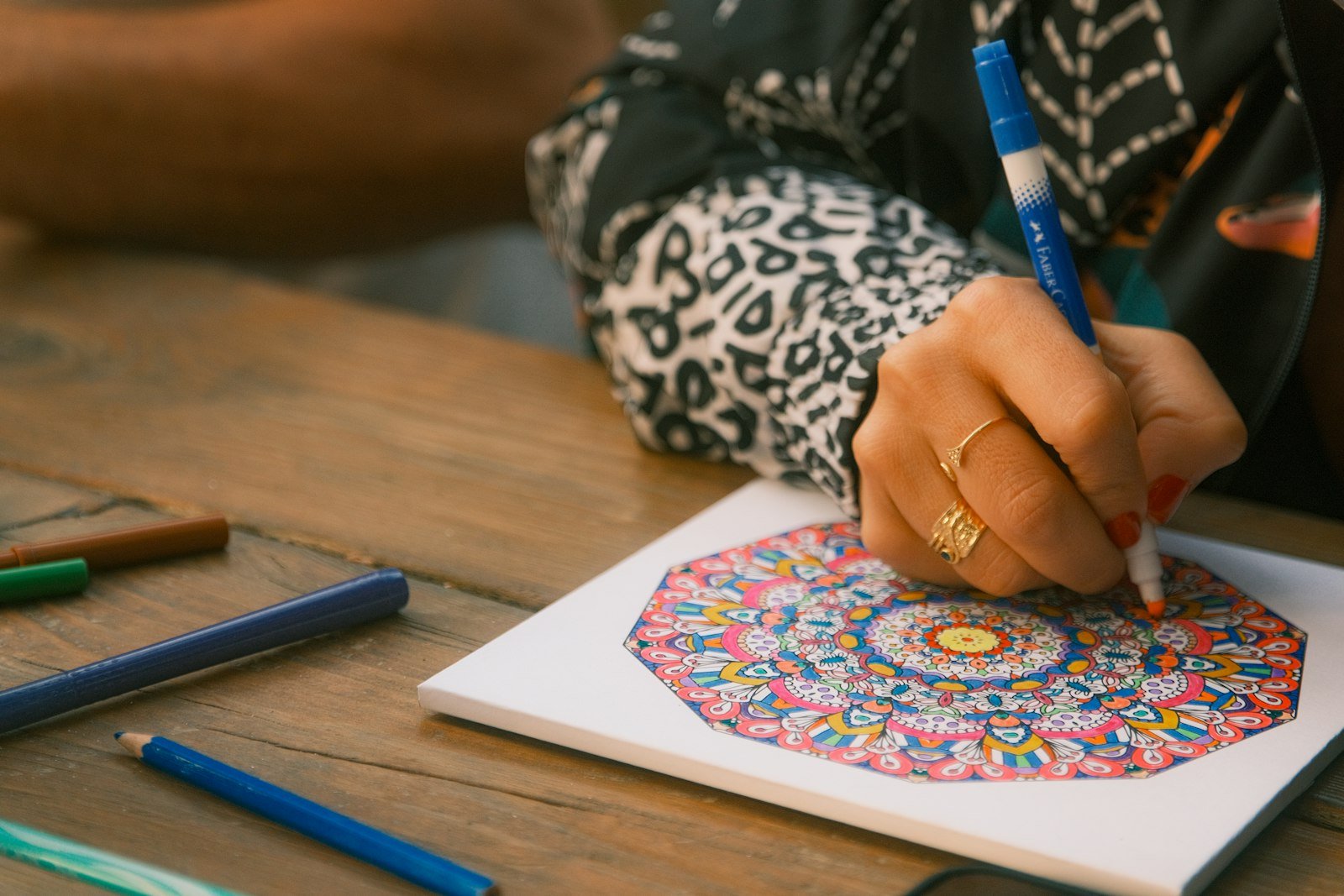
When most of us picture a coloring book, we think of childhood: crayons, cartoon animals, and a rainy afternoon. But in recent years, coloring has found a place in adult mental health care, too. Therapists are increasingly using structured coloring activities alongside talk therapy, and research is beginning to explain why it can help.
At ARC (Achieving Resilience Through Connection), we’re interested in simple, accessible tools that make healing feel more approachable. Here’s what we know about how coloring can support psychotherapy, especially Cognitive Behavioral Therapy (CBT).
Why the Brain Needs to Feel Calm Before It Can Change
CBT helps people notice unhelpful thought patterns, question them, and practice more balanced ways of thinking. That work relies on the brain’s “thinking” regions, especially the prefrontal cortex, which handles planning, reflection, and self-control.
The challenge is that when we’re anxious, upset, or overwhelmed, the brain’s alarm system takes over. In that state, it’s much harder to step back and think clearly. That’s why someone might understand a CBT skill perfectly in a calm moment, yet struggle to use it when emotions run high.
This is where coloring can help. Many clinicians describe it as working in two directions: “bottom-up,” by calming the body and nervous system, and “top-down,” by gently re-engaging the thinking brain so it’s ready for reflection.
Five Ways Coloring Can Support the Therapy Process
1. It helps calm the body’s stress response
Coloring is repetitive, predictable, and safe. Slow, rhythmic hand movements and focused attention can send a signal to the nervous system that there’s no immediate threat. Several studies have found that coloring structured designs, such as mandalas or patterns, can reduce self-reported anxiety, in some cases more than free drawing on a blank page. Researchers believe this calming effect works partly by easing the body’s fight-or-flight response.
2. It gently wakes up the thinking brain
Choosing colors, deciding where to start, and staying inside the lines all take a little planning and focus, but without the pressure of getting something “right.” This low-stakes engagement may help shift a person out of a reactive state and into one where they can think, reflect, and talk more openly. For many people, that makes it easier to move into the more demanding parts of a therapy session.
3. It interrupts worry and rumination
Anxiety and depression often involve getting stuck in loops of worry or self-criticism. Neuroscientists link this kind of repetitive, inward-focused thinking to a set of brain regions called the Default Mode Network. Coloring asks for just enough attention to pull focus into the present moment, toward colors, shapes, and the feel of the pencil, creating a short “pause” from those automatic negative thoughts.
4. It encourages a relaxed but focused state
Early brain research on art-making has found increases in alpha brainwave activity during drawing, a pattern associated with relaxed wakefulness. In this calm, attentive state, people may be more open to learning and practicing new ideas. Pairing a coloring page with a CBT concept, such as identifying a thinking trap or writing a kinder message to yourself, combines visual and verbal learning, which can make new skills easier to remember.
5. It offers small, visible wins
Finishing a section of a page gives quick, tangible proof of progress. One brain-imaging study found that coloring and other simple art activities activated areas of the brain linked to reward. For someone struggling with low motivation, those small moments of accomplishment can help build momentum, an important part of CBT approaches like behavioral activation.
How Coloring Fits Into Therapy
Coloring isn’t a replacement for therapy, but it can be a helpful companion to it. Some ways it can be used include:
- As a warm-up at the start of a session to help a client settle in and feel grounded.
- As a calming tool to use between sessions when stress or anxiety rises.
- As a conversation starter, since talking while coloring can feel less intense than face-to-face conversation, especially for young people.
- As homework, with pages built around CBT prompts like naming your inner critic, challenging a distorted thought, or tracking small daily steps.
Research in this area is still growing, and much of it is early or small-scale. Coloring works best as one tool within a broader care plan. If you’re dealing with ongoing anxiety, depression, or other mental health concerns, a licensed mental health professional can help you find the right mix of support.
Try It for Yourself
Want to experience this firsthand? Our free 10% Club Coloring Book for Recovering Perfectionists combines calming coloring pages with CBT-inspired weekly prompts, like naming your inner critic, starting messy, and practicing “good enough.”
You might also enjoy our related post, Procrastination Isn’t Laziness: Understanding It and Gently Moving Forward.
Calling Creative Designers: Help Us Co-Create Coloring Books
ARC is looking for creative designers and artists to co-create artistic coloring books for people of all ages, with a special focus on the neurodivergent community. We want to design pages that are welcoming, accessible, and meaningful for different ways of seeing, thinking, and feeling.
Our mission is to build resilience through connection, and part of that connection lives within us: our minds, our artistic curiosity, and our gift to see, feel, and create. If you’re an illustrator, graphic designer, art therapist, or simply someone who loves to make things and wants to use that gift to support mental health, we’d love to hear from you.
Sign up below, or email us directly at admin@arc-center.org.
Healing Grows Through Connection
At ARC, we believe resilience is built one small step at a time, and that no one should have to take those steps alone. Whether you’re looking for community, creative ways to cope, or a path toward professional support, we’re here to help. Explore our programs or reach out to learn more.
Further Reading
- Curry, N. A., & Kasser, T. (2005). Can coloring mandalas reduce anxiety? Art Therapy: Journal of the American Art Therapy Association, 22(2), 81–85.
- van der Vennet, R., & Serice, S. (2012). Can coloring mandalas reduce anxiety? A replication study. Art Therapy, 29(2), 87–92.
- King, J. L., & Kaimal, G. (2019). Approaches to research in art therapy using imaging technologies. Frontiers in Human Neuroscience, 13, 159.
- Coloring is good for your health, Mayo Clinic Health System.